
Robotics is transforming housekeeping into a science.
Catharine Beecher was reared in a God-fearing Calvinist home in which the state of her soul and the threat of hellfire were never far from awareness. Born at the turn of the nineteenth century in a Long Island village so remote it was considered Connecticut, her ministerial family impressed upon her the urgency to repent and experience conversion, that saving grace which would transform a believer into a true Christian. Conversion never came. But neither did any of the other expectations of marriage or motherhood. Even so, these ideals shaped the pages of everything Catharine wrote, including her 1841 bestseller Treatise on Domestic Economy. This four hundred–page housekeeping manual guided readers with instructions for every conceivable aspect of housework, from folding a shirt to pest control.
For those convinced that studying housekeeping was trivial, Catharine offered a correction:
Let the young women of this Nation find, that Domestic Economy is placed, in schools, on an equal or superior ground to Chemistry, Philosophy, and Mathematics, and they will blush to be found ignorant of its first principles, as much as they will to hesitate respecting the laws of gravity, or the composition of the atmosphere.
For Catharine, housekeeping was not a set of discrete tasks but a branch of knowledge with its own theories, objectives, and workflows. Like any field of study, housekeeping required training, and Catharine intended the Treatise to be the authoritative textbook for teaching it.
Managing a home was neither simple nor self-evident. Instruction in housekeeping was necessary because it was complicated, even dangerous. Consider laundry, the nineteenth-century’s most dreaded chore. Homemakers made their own soaps and washed clothes, bedding, curtains, table covers, furniture covers, and kitchen towels by hand. Catharine codified this undertaking into a multiday protocol that required careful attention to the balance of chemicals and their boiling points. Excess soda or lye in suds could cause chemical burns that resulted in blisters, infections, and scars. Severe chemical burns could lead to tissue damage or blindness. Without her health, a homemaker could not complete the vital duties upon which the family depended—duties numerous enough to require thirty-six chapters to explain.
Some of the work in the Treatise looks familiar—cleaning, gardening, meal planning, looking after children, folding and ironing clothes. These were but a fraction of the housekeeping expectations to which Catharine lent her expertise and counsel. A homemaker needed to know what remedies to administer if someone accidentally ingested arsenic, was struck by lightning, or bitten by a rabid dog. She needed to burn walnut—not chestnut—for firewood; to mix vitriol and saltpeter—or chloride of lime and water—to offset the smell of dead rats; to make whitewash from unslaked lime, salt, ground rice, Spanish whiting, and glue; to draw water from outdoor wells and cisterns and carry it indoors for home use; to track expenses and donate to worthy charitable causes; to manage the family calendar for maximum industry; to train and manage domestics; to cultivate the moral development of her household; and to do all of these and more without losing patience or face or pitying her condition.
Catharine promoted what seems, then and now, to have been an impossible standard for housekeeping. But for her, the stakes were worth it. Of homemakers, she wrote:
They are agents in accomplishing the greatest work that ever was committed to human responsibility. It is the building of a glorious temple, whose base shall be coextensive with the bounds of the earth, whose summit shall pierce the skies, whose splendor shall beam on all lands, and those who hew the lowliest stone, as much as those who carve the highest capital, will be equally honored when its top-stone shall be laid, with new rejoicings of the morning stars, and shoutings of the sons of God.
The Treatise was more than a housekeeping handbook—it was a blueprint for paradise. In its pages, Catharine shed the harsh tenets of the Calvinism in which she was raised. Predestination and the natural depravity of humans gave way to a warmer, optimistic vision of humanity and its future. One need not wait helplessly for God’s wrath and glory to remake the Earth at the end of time. If believers spread their faith and goodwill the world over, they could trigger the millennium, that thousand-year period of steadily advancing Christianization and global progress, and hasten the return of the Savior.
If the destiny of the world depended upon nations and the destiny of a nation lay with its citizens, then individual homes, where human character was shaped, were paramount. When a homemaker gazed up from her needlework in the parlor or her breadmaking in the kitchen, she might see spouses, children, siblings, parents, in-laws, cousins, nephews, nieces, or domestics, all with competing claims on her attention. Catharine whispered to her that this position was not a lowly one. It was of supreme importance. Through them, the homemaker was to accomplish her greatest work. She would construct the architecture of their souls. By way of her moral example, a domino effect of discrete individuals pursuing the moral good would spill over to purify the corruptions of society and collectively uplift the human condition. In Catharine’s epic, sweeping vision, homemakers would bring about the salvation of the world.
Perhaps it takes generations for a project as ambitious as Catharine’s to fully materialize. She demystified and professionalized housekeeping, but it is difficult to say that her ideas fully succeeded. Full adoption of the Treatise might not have been possible in her time, but perhaps it will soon be.
There is a new band of allies in the twenty-first century dedicating themselves to Catharine’s project. Some of the most intelligent people in the world, with PhDs in physics, mathematics, engineering, and computer science, are huddled around a monitor evaluating the ideal method of folding a shirt. It is the robotics engineers, data collectors, and researchers of today who are executing her vision in the most rigorous way possible.
Computer scientists have processed trillions of tokens to train neural nets to not only see a household item but understand it semantically. Engineers are mounting sophisticated sensors and depth cameras to empower computer vision and Vision-Language-Action models to fold T-shirts and socks fresh from the dryer. Startups are collecting hundreds of thousands of hours of teleoperation data to teach robots to load and unload dishwashers. Hardware specialists are designing custom grippers to pick up delicate foods like potato chips, raspberries, muffins, and bananas. Hackathon teams and hobbyists are testing the robustness of VR, simulations, and motion planning algorithms to map out in X-Y-Z space how a robot ought to navigate the chaos of an apartment collision-free. In short, roboticists measure success by asking if their robots are getting better at performing the very tasks found in Catharine’s 185-year-old Treatise.
Many engineers believe that the ultimate use case for robots is in homes and are racing to build low-cost models because they grasp the promise of the Treatise: the making of a home into a sanctuary. Should robots lighten our load, they might transform our dwellings into the spiritually nourishing spaces that Catharine imagined, but without the extreme self-abnegation that the nineteenth century demanded of homemakers.
Home is the dearest sphere of our life. Robotics might make it heaven on earth.
Catharine’s machines
Fig. 1 Dumbwaiter
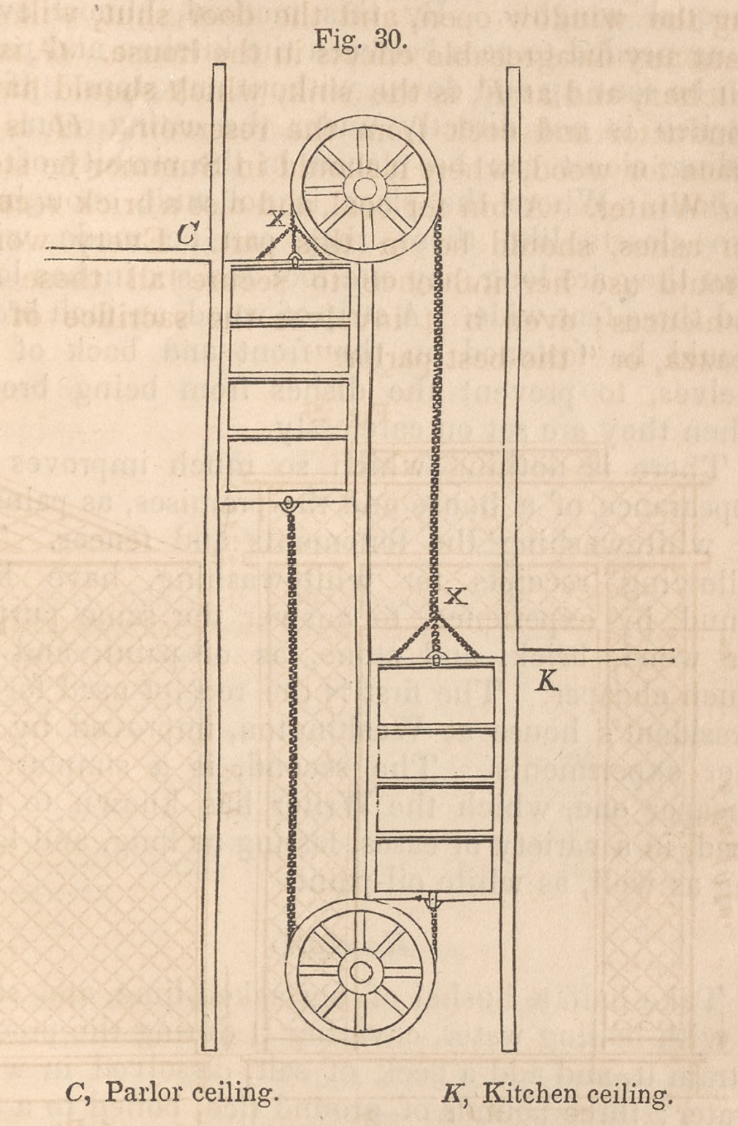
Some nineteenth-century kitchens were located in the basement, which required a homemaker to carry hot plates and heavy loads up and down the stairs. Catharine’s illustration shows how a dumbwaiter displaced this labor by transporting food and articles between a basement kitchen and upstairs parlor.
Fig. 2 Indoor plumbing
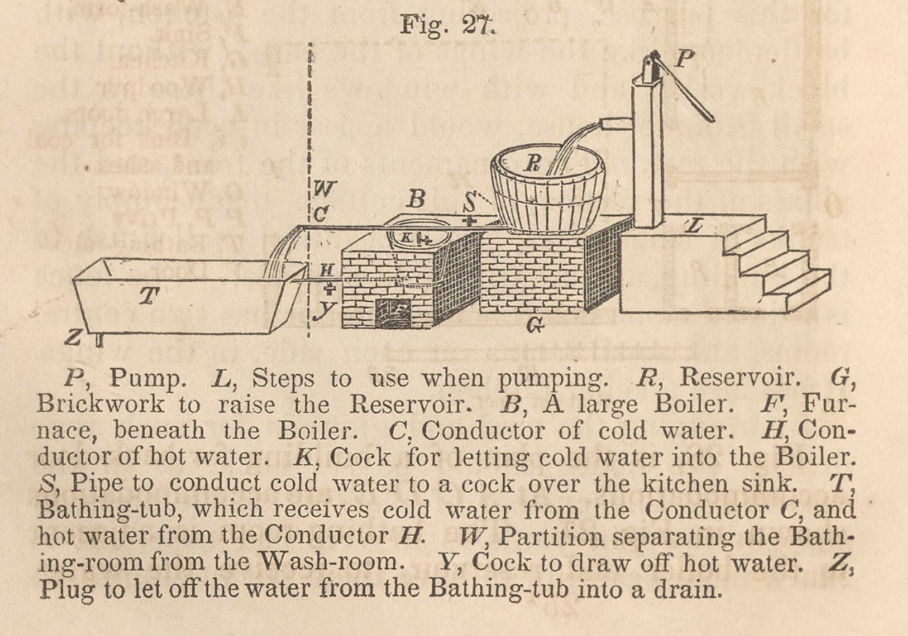
Instead of drawing distant water and carrying pails of it back home, Catharine suggested this indoor plumbing design which took advantage of an underground well or cistern to pump water directly into a bathroom and kitchen.
Bibliography
Barbara A. White, The Beecher Sisters (New Haven, CT: Yale University Press, 2003).
Catharine E. Beecher, Treatise on Domestic Economy, for the Use of Young Ladies at Home, and at School (Boston: Marsh, Capen, Lyon, Webb, 1841), HathiTrust, https://hdl.handle.net/2027/bc.ark:/13960/s2t0ncqn2t5.
Kathryn Kish Sklar, Catharine Beecher: A Study in American Domesticity (New York: Norton, 1976).
“Medical Management Guidelines for Sodium Hydroxide (NaOH),” Agency for Toxic Substances and Disease Registry, last modified October 21, 2014, https://wwwn.cdc.gov/TSP/MMG/MMGDetails.aspx?mmgid=246&toxid=45.